A project, change and investment management training provider. Please email mbh training with any questions relating to our training.
Wednesday, March 04, 2015
Welcome to our new website!
Wednesday, January 07, 2015
Students guidance and support all the way - its a requirement not an option.
We often get the...
"WOW, that stakeholder analysis is simple and yet informative", "the network diagram has opened my eyes"
"if only I had these tools when I was on the last project"
or
"it's great to share experiences with people from other industries, they face the same issues we do".
Thursday, May 03, 2007
Philosophies of Learning
Why should we have a philosophy? Well, some of the reasons noted by Hiemstra (1998) have been that having a philosophy can highlight an understanding of human relationships, it can help us to be sensitive and realise the requirements for positive exchanges towards other people, it can provide us with a framework for understanding personal values, and promotes flexibility and consistency when working with adult learners. All these principles are imperative to realising the intricate balance we as teachers/trainers require when involved in the education of adult learners.
As educators we should practice the art of reflection on all aspects of training not just the action of delivery, but ourselves, our views and beliefs, what influences us and how we influence the students. With regards to creating and understanding your philosophy try asking yourself;
• What are your perspectives on adult education,
• What is the role of the teacher and that of the learner,
• What are your ethical beliefs around standards of practice, certification and standards of teaching/ training?
• Why have a philosophy?
Once you have answered these questions have a look at the table below , you may identify where you believe you sit within the educational philosophies, however to gain a true indication I suggest you fill in the Philosophy of Adult Education Inventory by Lorraine M Zinn, PhD. This inventory assists you in truly determining where your philosophy lies and can be found at http://www.cals.ncsu.edu/agexed/aee523/paei.pdf .
Below is a table adapted from Galbraith , M(1990) outlining Philosophies and Traditions of Adult Education;

References:
Hiemstra, R. 1998, Translating Personal Values and Philosophy into Practical Action, in R.Brockett (ed) Ethical Issues in Adult Education, Columbia University, New York, pp.178-191.
Galbraith, M. 1990 Adult Leaning Methods, Ed. Kreiger, Florida.
Tuesday, April 10, 2007
What Adult Educators need to remember
Therefore educators need to understand where the student is coming from and ideally be empathetic to the needs of their students. The way in which adults learn has become of great importance through out the training industry, should we lecture to our students, is demonstration and practice applicable, via multi layered learning, or experiential learning to name a few.
All these are effective ways of training but consideration must be taken into account on the type of course we are running, it is not very effective just lecturing to a group of carpenters on how to make a table, they need to actually build it themselves with a degree of theory thrown in at the correct place to embed the learning.
Cultural Issues and experiences
In our multi culture society we need to take into account the backgrounds, culture and experiences of our students, there are such a myriad of questions we need to ask ourselves before we even step into the training environment.
Some of the questions we might ask ourselves are:
• How big is the group of students?
• What is the cultural mix of the students and are there any special requirements I will need if I training one type of cultural group from another;
• What is the age group as this can affect the ability for students to retain information
• Do we have activities to really get the group engaged?
• Have we catered for the different types of learning styles, pragmatist, activist, reflector and theorist (which have been designed by Honey and Mumford. UK);
• Are there any special needs required and how might I deal with this e.g. dyslexia, deafness;
• How should we set up the training environment?
However, we should try and remember that in a classroom of 20 students it is difficult to fill the needs of all, but as trainers we should endeavor to do so.
Too successfully transfer knowledge takes a mixture of education, life experiences and the well being of our bodies, these all contribute to how adults learn and how much we can take at certain stages of our life. As educators when we are delivering our programs we should think about age group and other circumstances, such as cultural background and gender to ensure we select activities to cater for these groups, this will help enhance the learning.
Our students have a great wealth of experience that should be encouraged to be shared as this will draw out a vast amount of knowledge for the group to digest and sharing this will encourage the students to participate. As students we can also realise our limitations and what can affect us as we grow older, we can then adjust our processes to help us embed the learning.
TIP:
Before you start your training course set up a safe environment with your students, get them to brainstorm some rules for the session and write them on a flip chart for all to see. You could even get someone ton police them and change the person every couple of hours to involve everyone.
Useful resources for adult education:
Knowles,M. Holton,E and Swanson R.A. (1998) The Adult Learner The definitive Classic In Adult Education and Human Resource Development.USA: Buttworth Heinmann
Lefrancois,G.R (2000) Psychology for Teaching.(10th edn)
Belmont, C A :Wadsworth Publishing
Sofo,F (1999) Human Resource Development. Perspectives, Roles and Practice Choices,Sydney: Business and Professional Publishing.

Thursday, October 05, 2006
mbh training blog
Thursday, September 14, 2006
Why are Adults returning to education?
Adults and the return to education
It has become increasingly popular that in our global society adults are surging back to education whether in Universities, TAFE, private enterprises or in house work places the trend is up and running. It seems the thirst for knowledge has grabbed the population around the world. In
Is it that adult education has become more accessible to us, or that companies are encouraging personal development from their staff, or competition for work has many adults realizing they need to have the piece of paper with the qualifications to become competitive in the market place?
When you speak to your friends, colleagues and neighbours you will find someone you know has also taken the title of ‘student’ amongst the others they already have and are juggling their work, home, study and family commitments to become further educated. I am sure candle shops everywhere are selling out to allow those people to burn the
Some things we do know about adult learning
There are many scenarios we can let run chaotically through our minds on why adults have returned to education but there are some things that we do know about adult learning;
- Some adults seek out learning to cope with life change events, such as a new job, marriage break ups, promotion, firing or moving to new cities.
- It seems the more life changing events an adult goes through then the more likely they will seek out new learning experiences.
- Maintaining ones self esteem and pleasure are strong motivators to undertake the learning journey
- Most adults that undertake learning do so 80 -90% of the time because they have a use for the knowledge or skill they are looking for.
- Courses need to be designed to accept viewpoints from people in different life stages with different value sets.
- Adults tend to take errors personally and this in turn leads to it affecting self- esteem.
Source: 30 things we know for sure about adult learning by Ron and Susan Zemke
Wednesday, September 13, 2006
The Work Breakdown Structure (WBS)

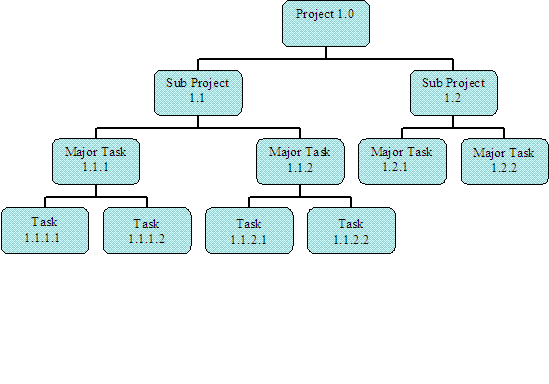
The work breakdown structure (WBS) defines the total scope of the project, work not in the WBS is outside the scope of the project. The WBS should be developed in a project planning workshop and is often used to develop a common understanding of the scope of the project. It’s graphical nature, and ability to be created via post-it notes on a flip chart allows the structure to be easily developed in a group environment.
- Each Level in the WBS represents an increasingly detailed description of the project. Each block in the WBS is assigned a unique number to identify it
- The WBS should be explicit and easily understood
- Take the output from the WBS and dump it into the designated scheduling tool.
Tips for developing a work breakdown structure (WBS)
Step 1: Identify tasks in the planning workshop
Step 2: Create task list
Step 3: Assign resources
Step 4: Estimate effort
Step 5: Work into graphical representation
Resource Pools and Master files
Once you have created a resource pool file you can link it to other project files, and each project file that uses resources from the resource pool is called a sharing file. When you share resources, the resource pool overwrites resource information in the sharing files by default if there any conflicting information.
What are the benefits of this functionality? Creating one resource pool allows you to create a master file that amalgamates the portfolio of projects into one file so you can report on resources, project timelines, costs and many other functions depending on what information you are trying to track over the reporting period .
The establishment of the resource pool and the creation of your project plans are important and involve the correct information technology set up including the version of MS Project ™ you are running on computers.
To learn more about this method and how you can manipulate tables, reports and views and more can be found in the mbh training one day MS Project ™ courses.
Tasks Estimating
Why? Some people will have the thought process of it should take me 2 days at 100 % of my time to write, however there is other work I have to do, so they add another day, plus an extra one to allow for other work ! By the time they give you there estimation a 2 day task turns into a 5 day one! Add the number of tasks up in your plan and think about how much extra time has been added and whether or not you really have a true indication of how long the project will take.
Now if we think about the actual work getting completed many people will look at the schedule and due dates and think they have enough time up their sleeve and delay starting the task until the last minute! Well this is student syndrome working at its best, but if the estimations are incorrect - be prepared to go off to your Sponsors and explain why your project is behind time.
So how do we reduce the impacts of this , we can apply several methods to assist us with estimation such as past experiences , Theory of Constraint or Monte Carlo Analysis , the list is endless. However one of the most effective ways is to ensure your project team are cohesive and explain the value of estimation to them, allow people to think about durations on tasks and the importance of those estimates when producing your project plans.
MS Project - Creating & updating your project plan
The debate is always around how many tasks and what level of detail should we include in our project plans, therefore setting up a plan that is mangable and applying some human processes around updating and tracking our plan is the key. The aim is not to spend too much time on administration of our project plans yet be able to see the impacts at a high level if we make changes to tasks and dates as the project progresses.
Some points that can help you to set up and get going.
- Ensure that you create a Work Breakdown Structure (WBS) in your planning workshop to scope your project.
- Apply durations to those tasks and keep the relationships as a Finsih to Start to provide you with an effective critcial path.
- Depending on the project and your management style think about how detailed your tasks need to be. Try breaking the tasks up into a minimum of 5 days in durations, if you have several 1 day tasks wrap them up under one.
- When you reach a critical phase of the project then you can break your tasks down into more detail for that period of time.
- Create the dependencies in your network diagram to ensure an accurate critical path is established, don't forget this process highlights the float of tasks and creates a the time line for your project enabling you to focus on what needs to be completed to meet your deadlines.
- Take the output and dump into MS Project or your scheduling tool
- Add those resources and durations
- Baseline the project plan
- Gather progress on a regular basis and ensure you update the plan.
- Enter actuals into the plan and change dates if applicable.
- Reschedule any tasks that have not started or are in progress at the status date to give you an up to date schedule.
- Don't get yourself bogged down in administration so you can get on with managing the project.
Remember as a project manager you are responsible for delivery of the project to time, cost, scope and benefits to name a few. Managing the plan will assist you with updating stakeholders to meet their expectations and scheduling of resources you will need. Therefore ensure you are comfortable with the scheduling tool you are using, and as project land constantly changes understand the impacts of these changes in the project plans.
What methods do you find are effective for you?
Friday, April 15, 2005
What are Learning Styles?
There are four types of learning styles developed by Peter Honey and Alan Mumford (1982) based on the work by Kolb (1984) that refer to how a person learns , these can change over their lifespan depending on their age , circumstances and mindset of the person. The learning styles are Pragmatist, Activist, Reflector and Theorist. Identifying your learning style this will determine the ideal way you will absorb information presented and therefore embed the learning. To identify your style you can complete a questionnaire that was developed by Honey and Mumford by going to http://www.peterhoney.com/product/learningstyles here you can drill down further into the learning styles and purchase the questionnaire to help identify your own style preference;

I am sure you will identify with one or more of the styles, maybe this will give you a sense of understanding why people do not take on the information the same way as someone else. The learning styles are one way to start to unlock the immense complexity of the human being and begin to gain some consideration on how we conduct training or transfer information that we require people to absorb.
Within adult education learning styles are a valuable asset for the trainers and developers, we need to ensure we take into them into consideration and include a variety of experiential activities, whether role plays, individual activities, group work or case studies. We are still witnessing training organisations going down the death by PowerPoint line believing this is the best way, if not only way to transfer information to the students. The definite reality is that students may absorb some information whilst they are trying to remain awake but they certainly will not gain maximum benefits from this type of training. Granted that sometimes PowerPoint can be useful on short presentations, but the reality is over a training course variety has to be the key to ensure knowledge transference and most importantly students enjoy the training course and will remember the content, embed into their daily activities and provide positive comments onto others about the training course they have attended. As a training organisation this is our goal.
More references for information on Learning Styles and theorists
Kolb, D.A. 1984. Experiential learning: experience as the source of learning and development. Englewood Cliffs, New Jersey: Prentice-Hall.
http://www.chelt.ac.uk/gdn/discuss/kolb1.htm
http://www.infed.org/thinkers/et-lewin.htm
http://www.support4learning.org.uk/education/lstyles.htm